

At a Glance
Pulpitis is inflammation of the pulp, the soft tissue with nerves and blood vessels inside a tooth. In children, it is most often caused by decay that has reached deep into the tooth. Parents may notice pain for no reason or at night, pain after cold or sweet foods, or chewing on one side. But the pain can be mild, and sometimes it goes away completely.
- Signs of pulpitis resemble other causes of toothache, so a diagnosis is not made from a single symptom.
- The cause is found at an examination: the dentist asks about the pain, examines the tooth and gums and takes an X-ray if needed.
- Further care depends on the state of the pulp, the tissues around the roots and whether the tooth can be reliably restored.
- Facial swelling, a fever or difficulty swallowing are reasons to get help the same day.
Jump to a Section
What Is Pulpitis in Baby Teeth?
Beneath the enamel and dentin, every tooth has pulp — living tissue that nourishes the tooth and lets it sense stimuli. When decay gets close to it, bacteria enter and the pulp becomes inflamed. Less often, the cause is an injury, a chip or a crack in the tooth.
In children, pulpitis in baby teeth sometimes develops beneath a cavity that looks small from the outside. Baby teeth have a thinner layer of hard tissue than permanent teeth, so decay has less distance to travel to reach the pulp.
At first, the inflammation can be reversible: if the decay is removed in time and the tooth is tightly sealed, the pulp can recover. If the inflammation goes on, the pulp can no longer heal by itself and eventually dies. The infection may then spread to the tissues around the roots. Only an examination can show what stage the inflammation has reached.
Symptoms of Pulpitis in Children: What Parents May Notice
A young child cannot always explain what exactly hurts. That is why changes in behaviour matter as much as complaints. Pay attention if:
- the tooth hurts on its own, for no obvious reason, or the pain wakes your child at night;
- pain after something cold, hot or sweet does not stop right away but lingers;
- your child chews on one side, refuses hard food or holds their cheek;
- you can see a dark spot, a hole or a broken edge on the tooth;
- pink tissue has appeared in the hole in the tooth and bleeds when brushed;
- there is swelling or a “pimple” on the gum next to the tooth, or a bad taste in the mouth.
None of these signs on its own proves that your child has pulpitis. Similar pain can come from decay without pulp inflammation, food stuck between teeth, gum irritation, teething or an injury. At the same time, several signs together, especially night pain or pain for no reason, are a reason not to put off an examination.
Have you noticed these signs in your child?
Let’s start with an examination: the dentist will find the cause of the pain and explain the next steps. Book an appointment Or call +38 (068) 168‑99‑11
Why “It Doesn’t Hurt” Does Not Mean the Tooth Is Healthy
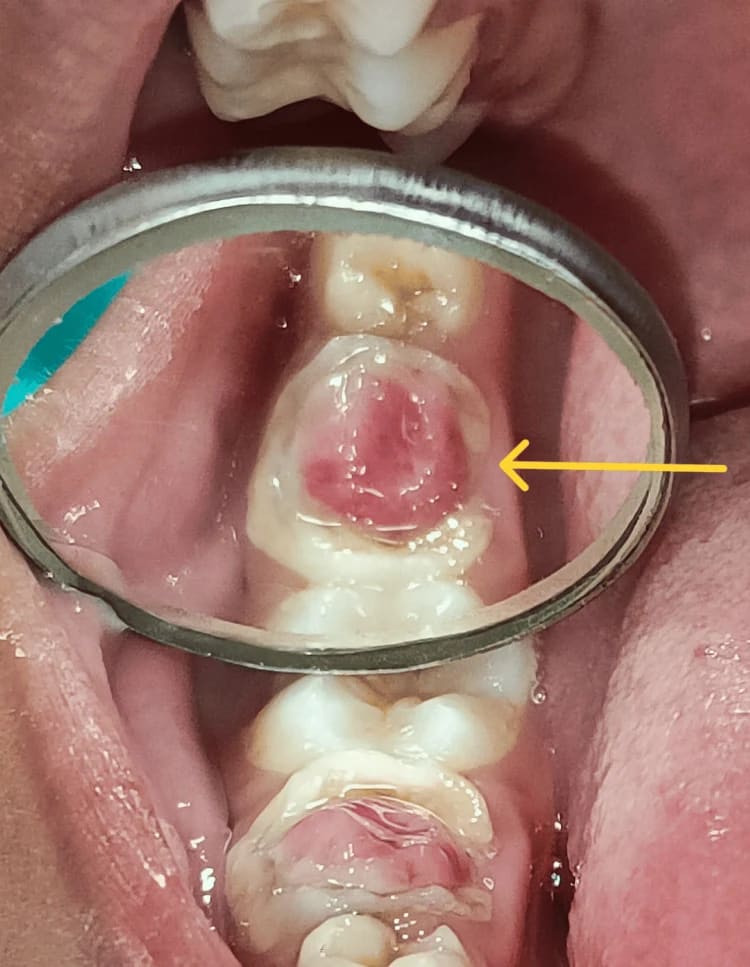
Pulpitis can continue for months without severe pain. The photo above shows chronic hyperplastic pulpitis in a child, also known as a pulp polyp. The girl complained only of occasional discomfort and bleeding when brushing. Chronic inflammation often causes exactly these mild, vague sensations.
It also happens that a tooth hurts for a long time and then the pain suddenly stops. This does not always mean recovery: when the pulp dies, the tooth may stop reacting to cold and heat. The infection, however, remains and may spread to the gum and the bone around the roots. So a tooth that has been hurting should be checked by a dentist even if your child no longer feels pain.
How a Dentist Finds the Cause of the Pain
A diagnosis is made up of several parts, and none of them is decisive on its own. At an appointment with a pediatric dentist, we start by talking with you and your child. We need to know when the pain started and how long it lasts. We also ask what triggers and what eases it, and whether it comes on by itself or at night.
Next, the dentist examines your child’s teeth, gums and face. They check whether the tooth hurts when gently tapped, whether it is loose and whether the gum is swollen. In baby teeth, testing with cold or a mild electric current gives unreliable results. That is why the conversation and the examination are especially important.
An X-ray shows how deep the decay has gone, the condition of the roots and the bone around them, and where the developing permanent tooth lies. The inflammation of the pulp itself cannot be seen on an X-ray. The dentist reaches a conclusion by combining the complaints, the examination and the X-ray. How to ease your child’s discomfort before the appointment is explained in our article on toothache in children.
How Pulpitis in Children Is Treated and What It Depends On
There is no single scenario for everyone. After the examination, the dentist weighs several factors:
| What the dentist assesses | Why it matters |
|---|---|
| State of the pulp | Whether the inflammation is still reversible, or the pulp can no longer heal or has died. |
| Tissues around the roots | Whether the infection has spread to the gum and bone: swelling, a “pimple” on the gum, changes on the X-ray. |
| How much of the tooth remains | Whether the crown can be reliably sealed and restored after treatment. |
| Roots and the time until the tooth is replaced | How far the roots have resorbed and when the tooth is due to be replaced naturally by a permanent one. |
| Your child’s general health | Chronic conditions, medicines and how comfortable your child is with treatment. |
Depending on this, the dentist will discuss with you whether the living part of the pulp can be kept, whether the root canals need treatment or, if the tooth cannot be reliably saved, extraction. Methods and what happens at the appointment are described on the Pulpitis Treatment for Children page. Our article on treating baby teeth explains why a baby tooth that will fall out anyway still needs treatment.
Pulpitis in children’s permanent teeth also occurs, for example in the first large molars that come through at around six years of age. The root of such a tooth is still growing, and living pulp is needed for its development. That is why the dentist tries to preserve it if the state of the tooth allows.
After pulp treatment, the tooth needs to be checked at follow-up visits. The dentist watches for pain, swelling or changes on the X-ray.
When Not to Delay
See a dentist the same day if toothache comes with swelling of the cheek or jaw, a fever, pain when biting, or if a painkiller does not help. Emergency help (103 or 112) is needed if your child has difficulty breathing, swallowing or speaking, or the swelling reaches the neck or the eye.
Don’t wait for the pain to get worse
In its early stage, pulp inflammation can still be reversed, so it is best not to put off an examination. Book an appointment Or call +38 (068) 168‑99‑11
Sources
- American Academy of Pediatric Dentistry. Pulp therapy for primary and immature permanent teeth. The Reference Manual of Pediatric Dentistry. Chicago: AAPD; 2025: 487–496. https://www.aapd.org/globalassets/media/policies_guidelines/bp_pulptherapy.pdf
- NHS. Toothache. https://www.nhs.uk/symptoms/toothache/
- NHS. Dental abscess. https://www.nhs.uk/conditions/dental-abscess/
- Cleveland Clinic. Pulpitis. https://my.clevelandclinic.org/health/diseases/23536-pulpitis
- Hennessy B. J. Pulpitis. MSD Manual Consumer Version. 2026. https://www.msdmanuals.com/home/mouth-and-dental-disorders/tooth-disorders/pulpitis
Images
- Pulp polyp in a baby molar of an 8-year-old child: Figure 1 from Parakh H., Thosar N. R., Chandra A., Pankey N. Diode Laser-Assisted Pulp Polyp Excision and Canal Disinfection in a Primary Molar: A Case Report. Cureus. 2024;16(2):e54315. Original: Cureus. License: CC BY 4.0. Changes: saved as WebP without resizing.
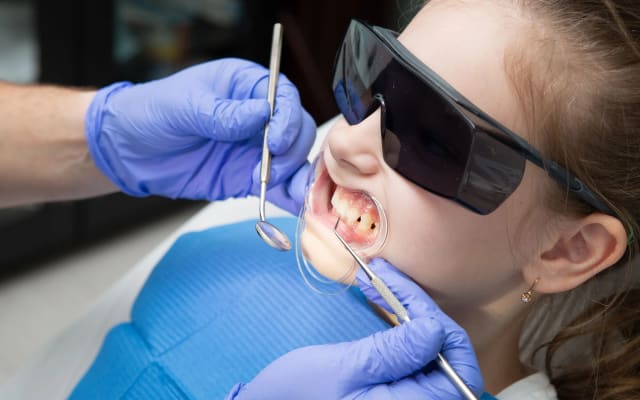
- Cover: a child having a dental examination in a dental chair. Author: Nadezhda Moryak. Original: Pexels. License: Pexels License. Changes: cropped to 4:3 and 16:10, saved as WebP.

FAQ
What are the symptoms of pulpitis in a child?
Can pulpitis in a child be painless?
The pain went away by itself. Could the pulpitis have cleared up without treatment?
Can pulpitis be seen on an X-ray?
If my child has pulpitis in a baby tooth, is the nerve or the tooth always removed?
Can pulpitis be cured at home or with antibiotics?
This article is for information only and does not replace a consultation. See a dentist for diagnosis and treatment.