
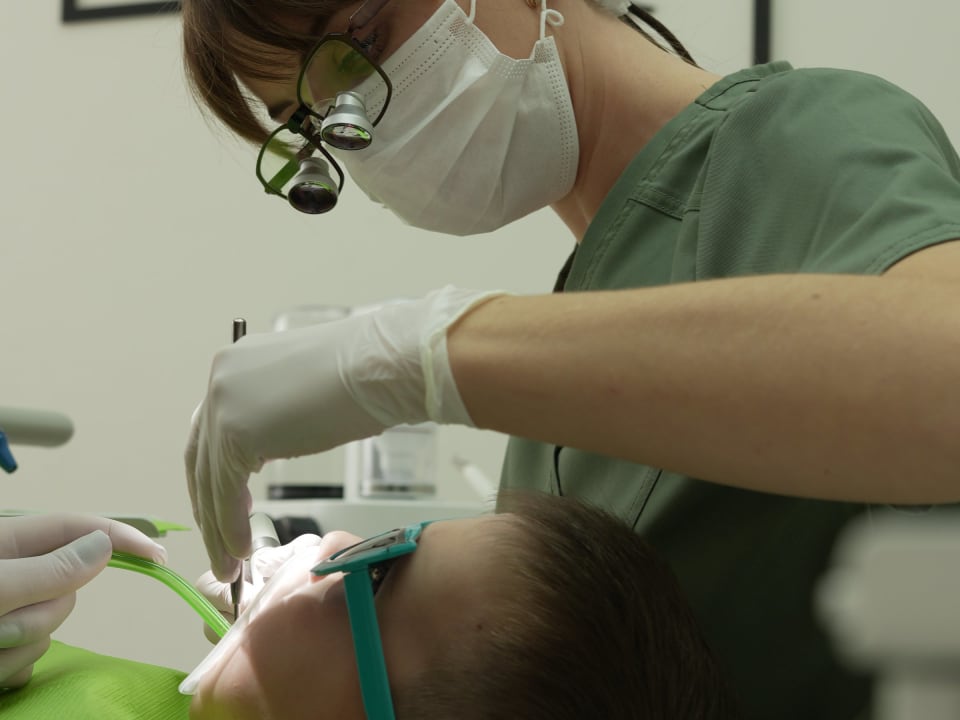


A child may need a minute to look around before sitting in the chair. That is fine. With us, there is no rush to begin: a few words, a look at the room and perhaps a ride in the dental chair come first.
Some children arrive with ten questions before they have even taken off their coat. Others stay close to a parent. A third agrees to sit in the chair but keeps their mouth firmly closed. There is no “correct” reaction to a dental visit.
The pediatric dentist takes this into account. A mirror can become the first object to explore. The chair goes up and down. A glove may turn into a tiny balloon. These simple things make the room feel less unfamiliar.
The first visit
It is easier to meet a kids dentist when nothing hurts. There is time to talk, count the teeth and let the child get used to the light above the chair. Even a short look inside the mouth is a useful start.
The dentist checks baby teeth, new permanent teeth, gums and the bite. Parents can ask whether brushing is effective and which areas the toothbrush keeps missing. If something needs attention, the explanation comes afterwards — clearly, without discussing a complicated plan over the child’s head.
A small note for parents: avoid phrases such as “it won’t hurt” or “there won’t be an injection”. Children often hear only the worrying word. Saying “the dentist will count your teeth” is usually enough preparation.
Signs worth checking
Decay in a baby tooth does not always begin with pain. It might first appear as a pale patch, a dark point or a rough area where food collects. Because the outer layers of baby teeth are relatively thin, the situation may change quickly.
Changes at mealtimes can say quite a lot. Perhaps your child suddenly uses only the left side, turns down crunchy food or wakes without an obvious reason. A swollen patch of gum, persistent bad breath, a spot on the tooth or a chipped edge is also worth showing to the dentist.
Falls happen. If the mouth took the impact, have a quick look at the teeth and gums. Blood, unusual movement or a tooth sitting differently than before means it is best to contact us.
Care from toddlers to teenagers
We are a pediatric dental clinic for children of different ages. Some appointments are simply check-ups. Others cover:
preventive check-ups and professional cleaning;
cavity treatment for children in baby and permanent teeth;
restoration of baby teeth.
These areas have their own pages, so we will not unpack each procedure here.
What matters on this page is the approach. The same appointment length will not suit every child. A school-age patient may cope well with a complete visit, while a toddler may do better with two short ones. The dentist chooses the pace after meeting the child.
When an ordinary appointment is difficult
Most pediatric dental treatment takes place in the chair. In some situations, we can also offer dental treatment under sedation or sleep dentistry for children.
These are separate treatment routes, not routine additions to an appointment. Whether either one is suitable is discussed with the parents after the child’s age, health and treatment needs have been considered.
After the appointment
Good pediatric dental care continues at home. The dentist may show a parent where plaque tends to remain or suggest changing the size of the toothbrush. Advice for a three-year-old will naturally differ from advice for a teenager with permanent teeth.
The date of the next check-up is individual too. It depends on what the dentist saw, how well the teeth are being cleaned and how quickly decay has developed in the past.
Booking an appointment
We provide pediatric dentistry in Bila Tserkva and also see families from Zhashkiv and Uman. Current fees are listed in the “Pediatric dentistry” section of our price list.
For an appointment, call +38 (093) 459 99 11 or +38 (068) 168 99 11.


