
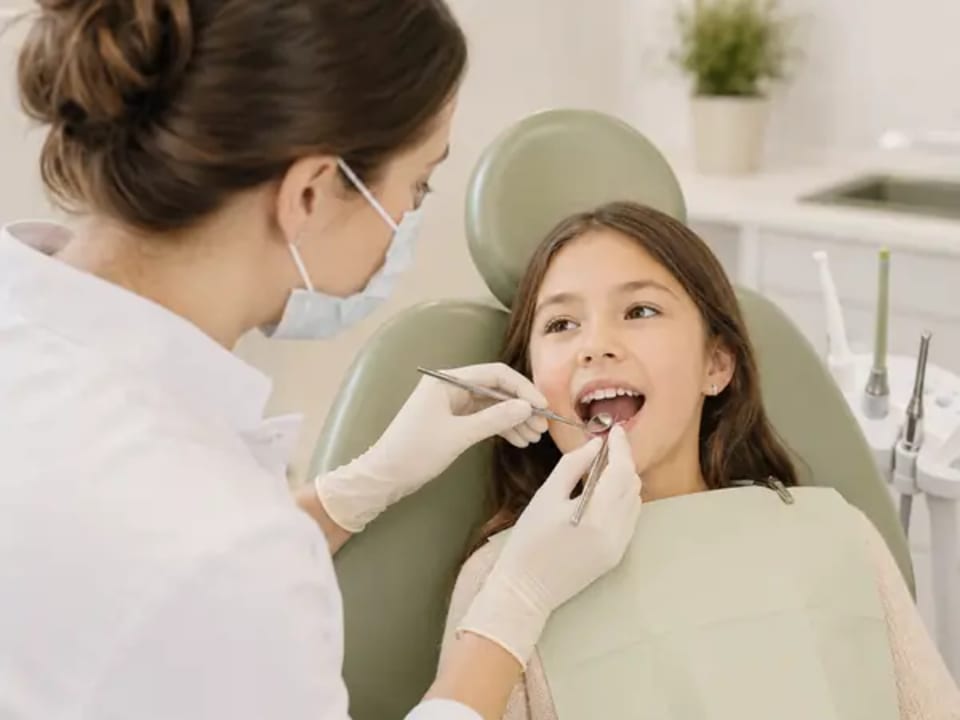
Has a tooth started waking your child at night? Does it keep aching after a warm drink, or hurt without an obvious reason? The pulp inside the tooth may be inflamed. With us, pediatric pulpitis treatment in Bila Tserkva begins with an examination and an X-ray. The dentist needs to find out how far the inflammation has travelled - and whether any healthy pulp can still be saved.
The Living Part of a Tooth
A tooth may seem like one solid piece. Under that white outer surface, though, there is a living core - the pulp. Fine nerve fibres share this cramped space with the tiny vessels that feed the tooth. Deep decay can upset the tissue long before a parent sees what is happening. Irritation comes first; inflammation may follow.
The distance is particularly short in a baby tooth. Its pulp chamber is relatively large, while the hard layer around it is thinner. So the dark spot a parent sees in the mirror may be only the visible part of a much deeper cavity.
Children rarely describe this in tidy dental language. One starts chewing only on the right. Sometimes the clues are almost mundane: the apple returns untouched, yoghurt does not. Then there is the child who wakes at 2 a.m. asking for help and seems completely well by breakfast. The pattern matters here: pain returns after the meal is over, hangs around or appears again at night. That is worth checking.
Why the X-Ray Can Change the Plan
Finding the problem tooth is not always obvious. A four-year-old may rub the whole left cheek, although only one small molar is responsible. And a calm afternoon does not cancel out a painful night - long-standing inflammation sometimes produces surprisingly few complaints.
The dentist looks for several pieces of the same puzzle. How deep is the cavity? Is the gum beside it swollen? Does the tooth move or react to light pressure? Then comes the X-ray, which shows the roots, nearby bone and the position of the permanent successor.
Once these details line up, the treatment plan becomes clearer. The term pulpitis treatment for children covers several procedures, so symptoms alone are not enough to choose one.
What Can Be Saved in a Baby Tooth?
The first question is not "pulpotomy or pulpectomy?" It is simpler: how much healthy pulp remains, and can the crown still be rebuilt?
When inflammation has not gone far, the dentist can remove the damaged dentine, protect the tissue underneath and seal the tooth. If the pulp inside the crown is affected but the tissue in the roots still looks suitable, a primary tooth pulpotomy may be used. Only the coronal portion is removed.
When the tissue in the canals is also affected, the treatment goes deeper. With a primary tooth pulpectomy, the canals are carefully cleared and then filled with a resorbable dental material. This matters in a baby tooth because its roots will gradually shorten as the permanent tooth approaches.
Most parents know this deeper option as root canal treatment for baby teeth. The label is only half the story. Before doing it, the dentist checks whether enough tooth remains above the gum to hold a dependable restoration and whether the infection is still local. When neither can be relied on, removal can give a more predictable result.
The options in short:
| Method | When it is considered and what is done |
|---|---|
| Pulp protection biological method | When: inflammation has not gone far. What is done: the damaged dentine is removed, the pulp is protected and the tooth is sealed. |
| Pulpotomy | When: the pulp in the crown is affected, while the root tissue still looks suitable. What is done: only the coronal portion of the pulp is removed. |
| Pulpectomy | When: the inflammation has spread to the root canals; the dentist determines the indication after diagnosis. What is done: the canals are cleared and filled with a resorbable material. |
| Removal | When: too little of the crown remains or the infection has spread. What is done: the dentist discusses this option with the parents. |
Which option suits a particular tooth is decided by the dentist after the examination and X-ray.
A Permanent Tooth with an Unfinished Root
A newly erupted permanent tooth still has growing to do below the gum. Its root walls may be thin and the tip not yet closed. Preserving living tissue, when the condition of the tooth permits, allows that development to continue.
Sometimes only the injured part of the pulp or the tissue inside the crown is removed. This belongs to vital pulp therapy. If the inflammation is too extensive, the dentist may need to move on to pediatric root canal treatment. The X-ray, symptoms and appearance of the tissue during treatment all contribute to that decision.
What the Visit Looks Like
Before touching the tooth, the dentist explains the plan in a way the child can handle. Some children want to know every detail. Some only need a short explanation and permission to raise a hand if they want a pause.
Next comes local anaesthetic. The dentist removes the decayed tissue and reaches the pulp, then follows the route chosen during diagnosis: protect what remains healthy, remove the coronal portion or clean the canals.
There is one more job after that. The opening must be closed tightly. A loose edge around the restoration gives saliva and bacteria a route back inside, undoing the work beneath it.
One visit or several? Both are possible. A straightforward tooth may be completed at once. Infection inside the canals, unusual anatomy or the need to check the tooth between stages can add another appointment. The dentist can estimate the timing after seeing the X-ray and beginning the treatment.
When treatment requires several complex steps and a child cannot stay still for long, treatment under anesthesia or sedation may be considered. For other services for children, see the pediatric dentistry section.


