

At a Glance
At what age do baby teeth fall out? The first ones start to wobble at about 6 years, and the last ones, the molars, are replaced at about 10–12. This is a guide, not a timetable. In some children the first tooth comes out a year later, and that can also be normal.
- The lower central incisors usually go first, then the upper ones, then the lateral incisors.
- The canines and baby molars are replaced later, between 9 and 12 years.
- A baby tooth falls out when a permanent tooth is growing under it and the root of the baby tooth dissolves.
- Take your child to a dentist if no tooth has come out by 8–9 years, a tooth was lost before 4 or after an injury, or a permanent tooth has already come in while the baby tooth is still firm.
Jump to a Section
At What Age Do Baby Teeth Fall Out?
A permanent tooth forms under the baby tooth. As it moves up, the root of the baby tooth dissolves, and the tooth is held only by a small piece of gum. Then it becomes loose and falls out. The table shows the approximate age at which baby teeth fall out and permanent teeth come in.
Approximate age of tooth replacement, years
| Baby teeth | Baby tooth falls out | Permanent tooth comes in |
|---|---|---|
| Central incisors | 6–7 | 6–8 |
| Lateral incisors | 7–8 | 7–9 |
| Canines | 9–12 | 9–12 |
| First molars (replaced by premolars) | 9–11 | 10–12 |
| Second molars (replaced by premolars) | 10–12 | 10–12 |
The table gives shared age ranges for the upper and lower teeth. Premolars, the small back teeth, come in where the baby molars were. There are 20 baby teeth, and every one of them is replaced by a permanent tooth. Another 12 permanent molars grow in at the back and replace nothing. Four of them are wisdom teeth, which come in much later, at 17–21 years.
The first permanent molars, or “six-year molars”, come in at about 6–7 years behind all the baby teeth. Nothing falls out before them, so they are easy to mistake for baby teeth. They are permanent teeth, and they need protecting from decay just like the rest.
In What Order Do Teeth Change?
Teeth usually fall out in the order in which they came in. The two lower central incisors go first, then the two upper ones. The lateral incisors are next. Between 9 and 12 years the canines and first molars change, and the order differs from child to child. The lower canines usually change a little earlier than the upper ones. The second molars are the last to change.
The pace is also individual. If your child’s first teeth appeared early, they may fall out early too, and the other way round. Teeth often fall out in waves: several in a row, then a long pause. You can read about when the first baby teeth appear in the article “Teething in Children”.
What Counts as Normal
Think in broad ranges rather than a specific month. The first tooth may start to wobble at about 6 years, or a year later. Usually a tooth first feels “funny”, then starts to wobble and comes out without much pain, often while eating or playing. If teeth change one after another and your child has no pain, we recommend simply watching.
What to Do While Teeth Are Changing
When a tooth is already loose
Let the tooth come out on its own. If your child is comfortable, they can gently move it with their tongue or clean fingers, but there is no need to push them. Do not pull a firm tooth. What to do when a permanent tooth has already come in but the baby tooth is still there is explained in the article “A Permanent Tooth Growing Behind a Baby Tooth”.
Caring for the teeth
Brush twice a day with fluoride toothpaste and help your child until they can brush well on their own. This is usually at 7–10 years. Clean between the teeth with floss once a day, and save sweets for mealtimes. You can read more about brushing in the article “How to Brush Children’s Teeth”.
A tooth that is about to fall out can also hurt because of decay. Pain is a reason to see a dentist, not to wait until the tooth falls out. We explain why this matters in the article “Do Baby Teeth Need Treatment”.
When to See a Dentist if Teeth Are Not Changing on Schedule
Small differences from the timing shown here do not in themselves mean that treatment is needed. Book an examination in the following situations:
- No baby tooth has come out by 8–9 years. The dentist will check how the permanent teeth are developing and decide whether further tests are needed.
- A tooth was lost before age 4, after an injury or because of decay. The neighboring teeth can drift into the empty space, and the permanent tooth will then have too little room.
- A permanent tooth has already come in, but the baby tooth is firm. The dentist will assess whether the baby tooth is getting in the way of the permanent one.
- A baby tooth has fallen out, but the permanent tooth is slow to appear. A permanent tooth usually comes in soon afterwards, but not always right away, especially if the baby tooth fell out too early and the permanent tooth is not yet ready to come in. If the gap stays empty for a long time, book an examination: the dentist can order an X-ray if needed.
Do not put off a visit if a tooth or the gums hurt or swell. Pain may be a sign of decay or inflammation rather than of changing teeth. Do not wait for a routine appointment if there is a high temperature, a swollen cheek or jaw, or enlarged glands in the neck.
Call Emergency Services (103 or 112) If
- Your child has trouble breathing, speaking or swallowing: do not wait for a dentist appointment.
- The mouth is badly swollen, the eye is swollen or hurts, or your child cannot open their mouth.
At the appointment, a pediatric dentist will assess how the teeth are changing, whether there is enough room for the permanent teeth and whether further tests are needed. You can read more about appointments and treatment for children on the Pediatric Dentistry page.
If the permanent teeth lack room or are coming in out of position, the dentist may recommend an orthodontist consultation. After the examination it will be clear whether watching is enough or bite correction is needed.
What the Table Does Not Show
The table gives average ranges. Age alone cannot confirm or rule out a problem with the bite or with the development of the permanent teeth.
If anything about the change of teeth seems unusual to you, it is better to come for an examination than to wait for the “right” age.
Book an Examination
We will look at how your child’s teeth are changing and tell you what to do next. If a baby tooth gets in the way of a permanent one, the dentist may suggest baby tooth extraction.
Sources
- American Dental Association. Eruption charts (baby teeth and permanent teeth). MouthHealthy.org. https://www.mouthhealthy.org/all-topics-a-z/eruption-charts/
- American Academy of Pediatrics. When Do Children Start Losing Their Baby Teeth? HealthyChildren.org. Updated 16 October 2026. https://www.healthychildren.org/English/healthy-living/oral-health/Pages/When-Children-Begin-to-Lose-their-Baby-Teeth.aspx
- Cleveland Clinic. When Do Kids Start Losing Their Teeth? (consulted pediatric dentist D. Gindi). 12 February 2026. https://health.clevelandclinic.org/when-do-kids-start-losing-teeth
- Mayo Clinic Staff. Baby teeth: When do children start losing them? 2 August 2024. https://www.mayoclinic.org/healthy-lifestyle/childrens-health/expert-answers/baby-teeth/faq-20058532
- Colgate Oral Care Center. When Do Baby Teeth Fall Out? (article reviewed by an oral health professional). 30 August 2024. https://www.colgate.com/en-us/oral-health/kids-oral-care/when-do-baby-teeth-fall-out
- NHS. Dental abscess: symptoms and when to get urgent help. Page last reviewed 18 March 2026. https://www.nhs.uk/conditions/dental-abscess/
Photos in the article
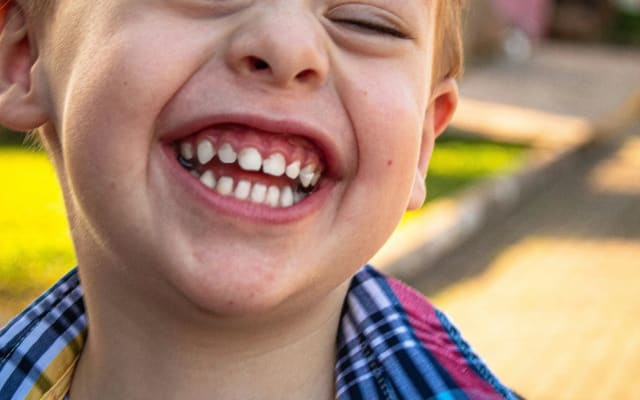
- Cover: a child’s mouth with a gap where a tooth has fallen out, “ToothLost-2917”. Author: Loadmaster (David R. Tribble). Original: Wikimedia Commons. License: CC BY-SA 3.0; the image in this article is shared under the same license. Changes: a reduced-size copy is used, cropped to 16:10 for the blog card and saved as WebP.

Article author: Svitlana Potikha
pediatric dentist, experience 8 years
More about the doctor and bookingFAQ
Which tooth falls out first?
Until what age do baby teeth fall out?
Do all baby teeth fall out?
Is it normal if teeth fall out later than in the table?
What if a baby tooth falls out very early?
Can I help a tooth come out?
This article is for information only and does not replace a consultation. See a dentist for diagnosis and treatment.