
At a Glance
When a permanent tooth grows behind a baby tooth that has not fallen out, a double row of teeth appears — often called “shark teeth”. It happens during the change of teeth and is not a disease in itself. What to do next depends on three things: whether the baby tooth is loose, whether there is pain or swelling, and where exactly the new tooth is coming in. Below we explain how to check this at home, when you can simply watch, and when an examination is needed.
Jump to a Section
- Why a Permanent Tooth Grows Behind a Baby Tooth
- What to Check at Home
- What to Do If the Baby Tooth Is Already Loose
- What to Do If a Permanent Tooth Is Growing Behind a Baby Tooth: Watch, Book an Examination or Get Urgent Help
- Will the Permanent Tooth Take Its Place After the Baby Tooth Comes Out?
- Does the Baby Tooth Always Have to Be Removed?
- When an X-Ray and an Orthodontist Consultation Are Needed
Why a Permanent Tooth Grows Behind a Baby Tooth
A permanent tooth usually forms under the root of the baby tooth. As it moves up, the root of the baby tooth dissolves, the tooth becomes loose and is held only by a small piece of gum. Then it falls out, and the permanent tooth takes its place.
Sometimes the permanent tooth develops not directly under the baby tooth but a little to the side. Then the root of the baby tooth dissolves more slowly, and the new tooth comes in behind or next to a tooth that is still firmly in place. This is normal and not a reason to worry in itself.
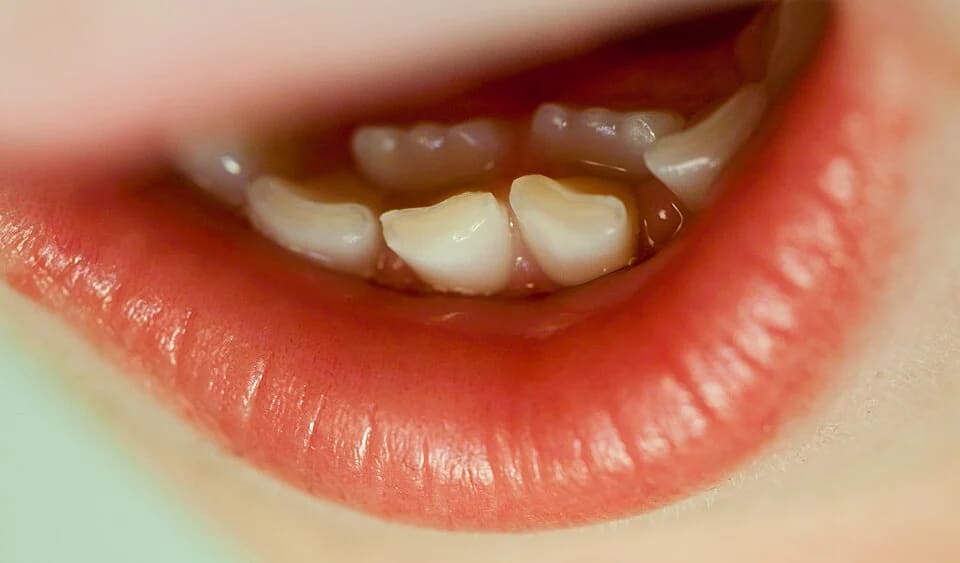
Front teeth start to change at about age 6, so parents notice a double row at the front at that age. Every child has their own pace, so go by the condition of the tooth rather than by age.
What to Check at Home
Look at your child’s teeth in good light and check four things.
- How loose the tooth is. Children often feel that a baby tooth is “funny”: it shifts when they eat or hurts when they brush.
- Pain. A tooth that does not hurt is a reason to watch, while severe pain is a reason to see a dentist.
- The condition of the gums. They may be calm and pink, or they may turn red, swell and become sore to the touch.
- The position of the new tooth. It may come in behind the baby tooth, next to it, or off to the side of the line of teeth.
What to Do If the Baby Tooth Is Already Loose
Patience is enough here: a loose baby tooth usually comes out on its own. If your child is comfortable, they can gently move it with their tongue or clean fingers. There is no need to push them to do it. If the tooth stays loose for a long time without coming out, or the gum around it turns red or hurts, show your child to a dentist.
- Wash your hands and your child’s hands before touching the tooth.
- Do not pull a firm tooth, and do not make your child wiggle a loose one.
- Brush twice a day, gently going around the new teeth.
What to Do If a Permanent Tooth Is Growing Behind a Baby Tooth: Watch, Book an Examination or Get Urgent Help
Three situations: what you see and what to do
| When to Get Help | Signs | What to Do |
|---|---|---|
| You Can Watch | The baby tooth is loose, and your child wiggles it themselves. Nothing hurts, the gums are calm and your child eats as usual. | Let the tooth come out on its own and watch that the signs do not change. |
| Book an Examination | The baby tooth is firm, and the permanent one has already come in next to it. The tooth does not loosen, although your child wiggles it. The new tooth grows crooked: it leans sideways or forward. | Book a dentist: we will assess the tooth, take an X-ray if needed and decide whether we can keep watching. |
| See a Dentist Urgently | The tooth or gums hurt badly, or there is a high temperature. The gum or cheek is swollen, there is redness, or the glands in the neck are enlarged. | Do not wait for a routine appointment: call the clinic and describe the symptoms. |
Call Emergency Services (103 or 112) If
- Your child has trouble breathing, speaking or swallowing: do not wait for a dentist appointment.
- The mouth is badly swollen, the eye is swollen or hurts, or your child cannot open their mouth.
Will the Permanent Tooth Take Its Place After the Baby Tooth Comes Out?
In most cases it will: once the baby tooth has fallen out or been removed, the permanent tooth has a clear path and can move into the right position.
What does it depend on? On how far the new tooth is from the line of teeth, whether it has enough room in the jaw and whether anything is blocking it. A lack of room for the lower front teeth is typical at this age. Mild crowding often lessens as the jaw grows, but not in every child, so we assess it at the examination rather than by eye.
Does the Baby Tooth Always Have to Be Removed?
No. If the baby tooth is loose, it is usually enough to let it fall out on its own. Removal is considered when the tooth does not move and prevents the permanent one from coming in where it belongs.
At the examination we check how loose the tooth is and the condition of its roots, look at where the permanent tooth lies and decide whether we can keep watching. If the tooth is firm and in the way, we suggest removing it, and we numb the area first. How it goes is described on the Baby Tooth Extraction page.
When an X-Ray and an Orthodontist Consultation Are Needed
An X-ray is needed when the baby tooth is firm or has stayed in too long, and it is unclear from the outside what is happening under the gum. It shows the root of the baby tooth, how far it has dissolved and the position of the permanent tooth. A retained baby tooth is sometimes linked to a missing permanent tooth or to an extra tooth blocking the way. This can only be seen on an X-ray.
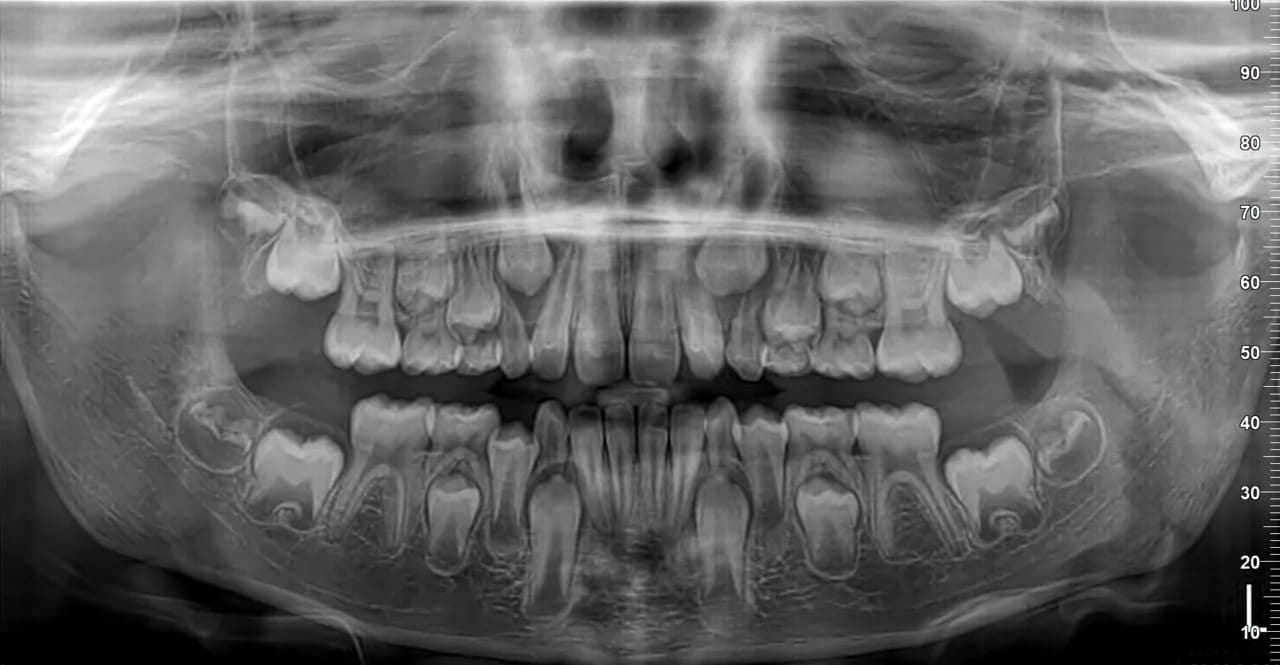
See an orthodontist if, after the baby tooth has fallen out or been removed, the permanent tooth stays crooked or turned, or does not have enough room. The orthodontist assesses the bite and the space in the jaw and tells you whether treatment is needed now or watching is enough. Read more on the Bite Correction page.
When an Individual Assessment Is Needed
General rules are not enough when it is not just one tooth changing with age. In these cases we recommend an examination with an X-ray.
Your child has not lost a single baby tooth by the age of 8–9.
Several baby teeth are retained at once, especially if your child has other health complaints: the causes are then looked for more widely.
A baby tooth was treated earlier with root canal filling and has stayed in: such a tooth is assessed for removal.
Permanent teeth come in unevenly, or a permanent tooth is long absent where a baby tooth was lost: the cause may be a missing or an extra tooth.
Book an Examination
Book an examination with us: we will check how loose the tooth is and where the new one is coming in, take an X-ray if needed and tell you whether an orthodontist is needed. General information about children’s treatment is on the Pediatric Dentistry page.
Sources
- American Academy of Pediatrics. When Do Children Start Losing Their Baby Teeth? HealthyChildren.org. Updated 16 October 2026. https://www.healthychildren.org/English/healthy-living/oral-health/Pages/When-Children-Begin-to-Lose-their-Baby-Teeth.aspx
- Cleveland Clinic. When Do Kids Start Losing Their Teeth? (consulted pediatric dentist D. Gindi). 12 February 2026. https://health.clevelandclinic.org/when-do-kids-start-losing-teeth
- Health New Zealand. Over-retained teeth (patient leaflet HE1267). April 2026. https://healthed.govt.nz/cdn/shop/files/Over-retained_teeth.pdf
- Leung C.W.M., Leung T.F. Retained primary teeth: a clinical complaint not to be dismissed. Paediatr Child Health. 2024;29(3):133–134 (published online 18 October 2023). https://doi.org/10.1093/pch/pxad069
- American Academy of Pediatric Dentistry. Management of the Developing Dentition and Occlusion in Pediatric Dentistry. The Reference Manual of Pediatric Dentistry, 2026–2027, pp. 525–543 (revision 2024). https://www.aapd.org/research/oral-health-policies--recommendations/management-of-the-developing-dentition-and-occlusion-in-pediatric-dentistry/
- NHS. Dental abscess: symptoms and when to get urgent help. Page last reviewed 18 March 2026. https://www.nhs.uk/conditions/dental-abscess/
Photos in the article
- A double row of lower front teeth in a child, “Milchzahn Haifischgebiss”. Author: Event123. Original: Wikimedia Commons. License: CC BY-SA 3.0; the image in this article is shared under the same license. Changes: saved as WebP, not cropped.
- A panoramic X-ray of the jaws of an 8-year-and-7-month-old boy, “Pano8”. Author: Roquex. Original: Wikimedia Commons. License: CC0 1.0. Changes: reduced in size and saved as WebP.
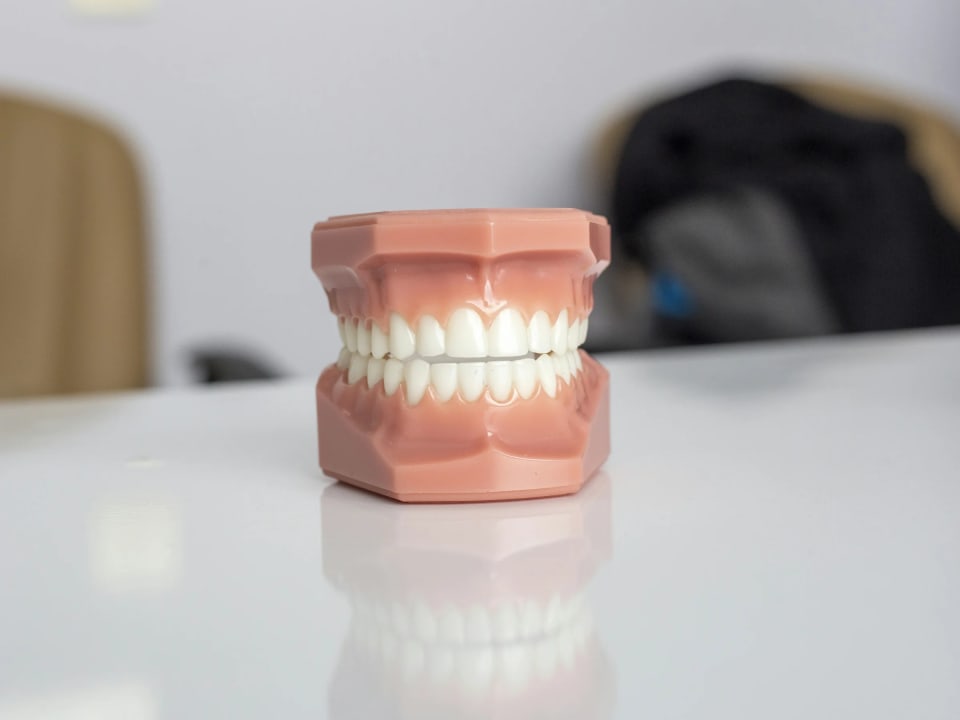
- Cover: a model of the jaw with teeth, “Orange plastic container on white table”. Author: Enis Yavuz. Original: Unsplash. License: Unsplash License. Changes: cropped to 4:3 and 16:10, saved as WebP.

Article author: Olha Poberezhnyk
pediatric dentist, experience 10 years
More about the doctor and bookingFAQ
What are “shark teeth” in children?
Is it dangerous when a permanent tooth grows behind a baby tooth?
Does a baby tooth always have to be removed?
Can I remove a baby tooth myself?
Will the permanent tooth take its place on its own?
Does it hurt to remove a baby tooth?
When should I see a dentist if baby teeth are not falling out?
This article is for information only and does not replace a consultation. See a dentist for diagnosis and treatment.