
At a Glance
Inflamed gums around a wisdom tooth are usually pericoronitis: an infection of the gum that partly covers a wisdom tooth that has not fully come through. Without treatment it keeps coming back and can become complicated.
- The cause is a space under the gum where food gets stuck and the brush barely reaches.
- Signs: pain, a swollen gum, a bad taste, food getting stuck; as it worsens — a fever.
- Do not take antibiotics on your own: the basis of treatment is local care by a dentist.
- If the inflammation keeps coming back, the dentist may suggest removing the tooth.
Jump to a Section
What Is Pericoronitis of a Wisdom Tooth?
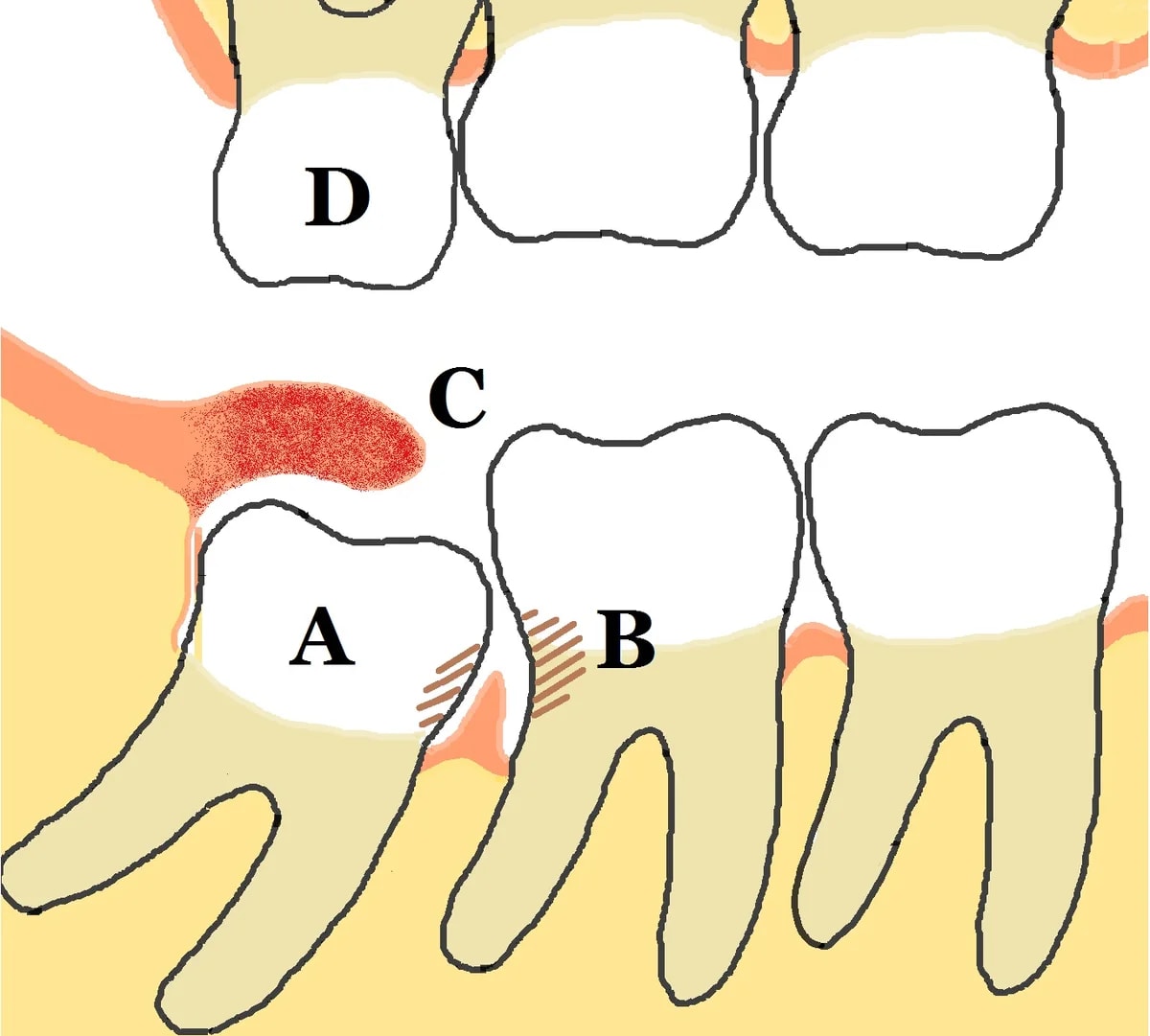
Wisdom teeth come through later than the others — in the teens or early adulthood. If there is not enough room for the tooth, it may be blocked by another tooth or partly covered by gum. Inflammation of the gum over such a tooth is called pericoronitis; in everyday speech it is inflammation of the “hood” of the wisdom tooth. It is one of the reasons a wisdom tooth ends up being removed.
Why Gums Become Inflamed Around a Wisdom Tooth
The wisdom tooth has shown a little above the gum, but the brush barely reaches there, and food and plaque get stuck under the gum. The gum swells from time to time and then everything seems to pass — but the cause remains.
The likelihood of pericoronitis depends on the position of the tooth. A lower wisdom tooth that stands vertically and is partly through becomes inflamed more often than teeth in other positions.
Symptoms of Pericoronitis
The signs usually appear right at the tooth. A more worrying signal is when the inflammation spreads.
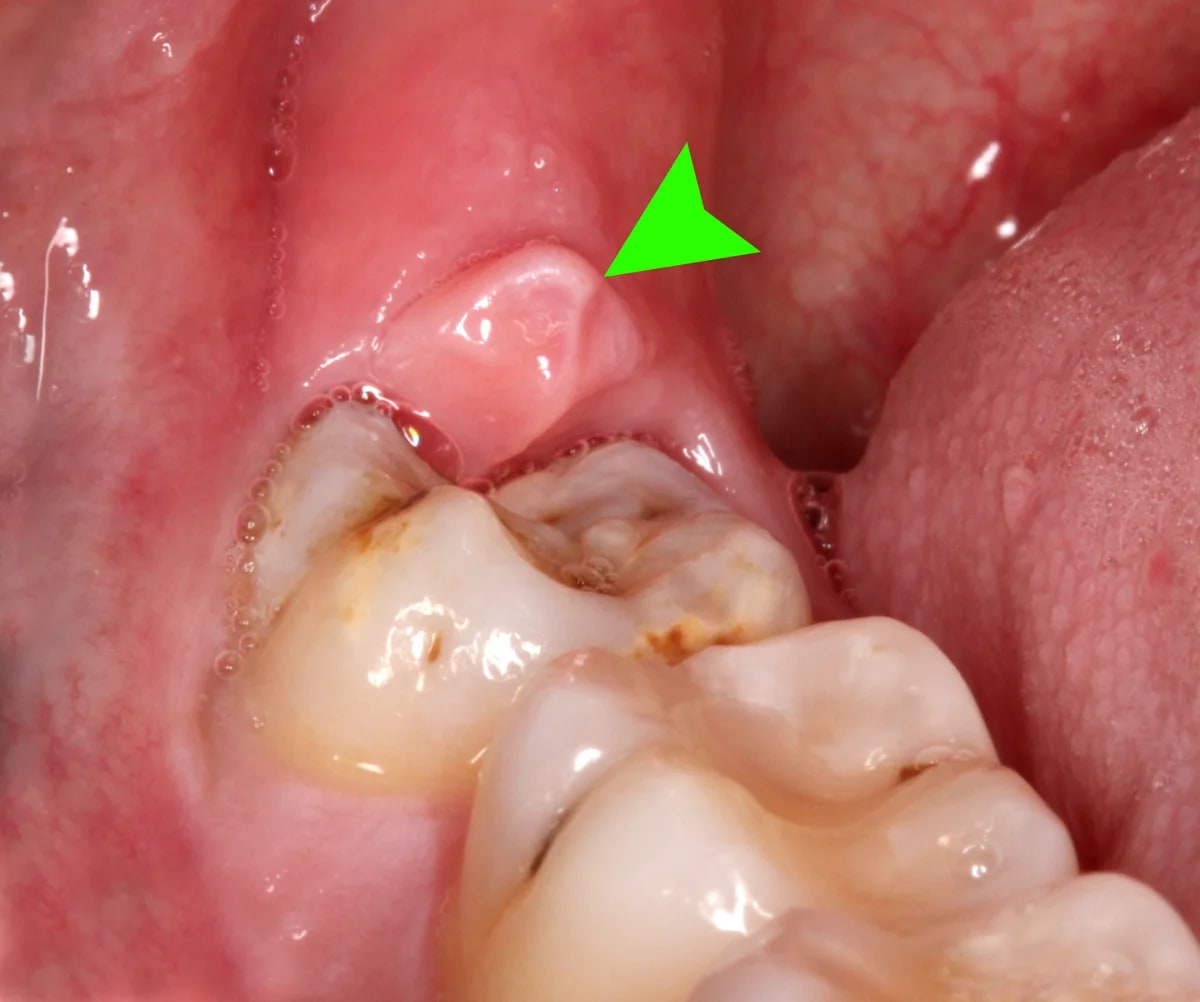
Near the Wisdom Tooth
Pain and swelling of the gum
The gum over a partly erupted tooth hurts and swells.
Food getting stuck
Food gets stuck under the gum, and the brush barely reaches there.
A bad taste
It is felt in the mouth along with the pain and swelling.
When the Inflammation Spreads
Fever
Your temperature may rise.
Feeling unwell
A general feeling of being unwell appears.
Growing pain
The pain gets stronger instead of passing.
What to Do If the Gum Around a Wisdom Tooth Is Swollen
- Book a dentist — the dentist will examine the area and, if needed, order an X-ray.
- To ease the pain you can take ordinary painkillers such as ibuprofen or paracetamol, following the instructions.
- Adults can rinse the mouth with warm salt water.
- Eat soft food and brush gently without touching the painful area with the brush.
- Do not take antibiotics without a doctor’s prescription.
Preference is given to local treatment, and antibiotics are kept for severe conditions. There are no reliable controlled studies yet of the benefit of systemic antibiotics specifically in pericoronitis.
How Pericoronitis Is Treated and When the Tooth Is Removed
Most cases of pericoronitis can be treated locally: often neither antibiotics nor immediate removal of the tooth is needed. The main aim is to clear out whatever gets trapped under the “hood” and to stop it building up again.
What the Dentist Does During Acute Inflammation
- Examination and X-rayThe dentist examines the gum, assesses the position of the tooth on an X-ray and checks for signs that the infection is spreading. Without an X-ray, the shape of the roots and what is happening under the gum cannot be seen.
- Rinsing under the “hood”The space under the gum is rinsed with a sterile solution or a mucosal antiseptic, for example chlorhexidine or hydrogen peroxide.
- Clearing plaque and food debrisPlaque and food debris are gently removed from the pocket under the gum with special instruments. If pus has collected there, it is drained.
- Stopping the gum being bittenIf a tooth from the opposite jaw bites into the inflamed gum, the dentist adjusts the gum or the bite; sometimes removal of that tooth is considered.
- Home care and a check-upThe dentist shows you how to clean the area gently and rinse with an antiseptic, and books a follow-up visit to check the result.
The dentist adds antibiotics to local treatment only when the infection has spread or there are general symptoms, such as a fever.
Removing the Tooth or Trimming the “Hood”
A first episode of pericoronitis, unless it is particularly severe, is usually not a reason for surgery. When the inflammation comes back a second time or more, the dentist discusses a surgical solution. There are two routes.
Removing the tooth is the definitive solution. It is considered when the inflammation keeps returning and the tooth has no chance of settling into a proper position. The dentist takes into account how the tooth sits, how close the mandibular canal runs and your general health; once the decision is made, there is no point in putting it off without a reason.
Trimming the “hood” (operculectomy) is an alternative: the dentist removes the gum that covers the tooth so the crown can be cleaned with a brush. It is done with a scalpel, a laser or cautery. After such surgery there is usually less pain and fewer complications than after removing the tooth, but the result is checked at a follow-up visit, and if it has not been achieved, the gum is adjusted again.
Which solution suits you depends on the position of the tooth. If a wisdom tooth does not hurt, the decision about removal is made by the dentist after an examination and an X-ray.
When Home Measures Are Not Enough
Painkillers and rinsing only ease the symptoms. While plaque and food debris stay under the “hood”, the inflammation can come back, so the cleaning under the gum has to be done by a dentist. If the inflammation keeps coming back or there is no room for the tooth, a surgeon is needed: they will assess whether to remove the tooth or to trim the “hood” instead.
Let’s Start With an Examination
Our surgeon removes wisdom teeth after an examination and an X-ray. Learn more on the Wisdom Tooth Removal page; for surgical care in general, see Dental Surgery.
When Not to Put Off a Visit
Go right away if the cheek, neck or area around the eye is swollen, it is hard to open your mouth, swallow or breathe, you have a high fever, or the pain keeps growing and does not go away with painkillers.
Sources
- NHS. Wisdom tooth removal. https://www.nhs.uk/tests-and-treatments/wisdom-tooth-removal/
- NHS. Toothache. https://www.nhs.uk/symptoms/toothache/
- Schmidt J., Kunderova M., Pilbauerova N., Kapitan M. A review of evidence-based recommendations for pericoronitis management and a systematic review of antibiotic prescribing for pericoronitis among dentists. Int J Environ Res Public Health. 2021;18(13):6796. https://doi.org/10.3390/ijerph18136796
- Leroy R., Bourgeois J., Verleye L., Toma S. Should systemic antibiotics be prescribed in periodontal abscesses and pericoronitis? A systematic review of the literature. Eur J Oral Sci. 2022;130(4):e12884. https://doi.org/10.1111/eos.12884
- Galvão E.L. та ін. Association between mandibular third molar position and the occurrence of pericoronitis: a systematic review and meta-analysis. Arch Oral Biol. 2019;107:104486. https://doi.org/10.1016/j.archoralbio.2019.104486
Photos in the article
- Diagram of pericoronitis around a lower wisdom tooth, file “Lower mandibular third molar impaction pericoronitis diagram.jpg”. Author: Lesion. Original: Wikimedia Commons. Licence: CC0 1.0. Changes: reduced to 1200 px wide and converted to WebP.
- A swollen gum flap over a wisdom tooth, file “48 clinical pericornitis.jpg”. Author: Coronation Dental Specialty Group. Original: Wikimedia Commons. Licence: CC BY-SA 3.0. Changes: reduced to 1200 px wide and converted to WebP, no cropping.

FAQ
What is pericoronitis?
Why do gums become inflamed around a wisdom tooth?
What should I do if the gum around a wisdom tooth is swollen?
Are antibiotics needed for pericoronitis?
Does the tooth have to be removed after pericoronitis?
This article is for information only and does not replace a consultation. See a dentist for diagnosis and treatment.