
At a Glance
Gingivitis in children is gum inflammation that is most often caused by dental plaque. The gums turn red, swell and bleed during brushing, but there is usually no severe pain. Gingivitis is reversible: the gums recover when plaque is removed regularly at home and by the dentist. Take your child to a dentist as soon as you notice redness or bleeding of the gums. If the gums are very sore and swollen, or ulcers appear in the mouth, contact the clinic without waiting for a routine appointment. If a fever comes together with blisters or ulcers, see a doctor without delay.
Jump to a Section
What Is Gingivitis in Children?
Gingivitis is inflammation of the gums that does not destroy the tissues holding the tooth in place, which is why it is considered reversible. It is the most common gum disease in children and adolescents, and in children it is usually milder than in adults.
The cause of the inflammation is dental plaque, a soft film of bacteria on the teeth near the gums. When plaque is not removed, the bacteria irritate the gums and they become inflamed.
Why Gums Become Inflamed in Children
Plaque builds up when teeth are not brushed thoroughly enough. Children also have factors that make their gums inflame more often:
| Factor | How it affects the gums |
|---|---|
| Brushing without help | A child cannot yet brush well without help, so plaque stays along the gum line and between the teeth. |
| Teeth coming in or getting loose | Around a tooth that is coming in or getting loose, the gums inflame more often, and a partly erupted tooth is hard to clean. |
| Decay, crowding, braces | Plaque collects on decayed teeth, crowded teeth, overhanging filling edges and braces. |
| Mouth breathing | Because of allergies or enlarged adenoids, the gums dry out, and saliva washes plaque away less well. |
| Adolescence | At about 11–14 years, hormonal changes make the gums react more strongly to the same plaque. |
| Sugar and snacks | Sweets and frequent snacks make plaque build up more easily. |
In rarer cases the inflammation has nothing to do with plaque: an infection, certain medicines or a general health condition can be behind it. That is why a dentist looks beyond hygiene and checks for other causes.
What Gingivitis in Children Looks Like: Symptoms
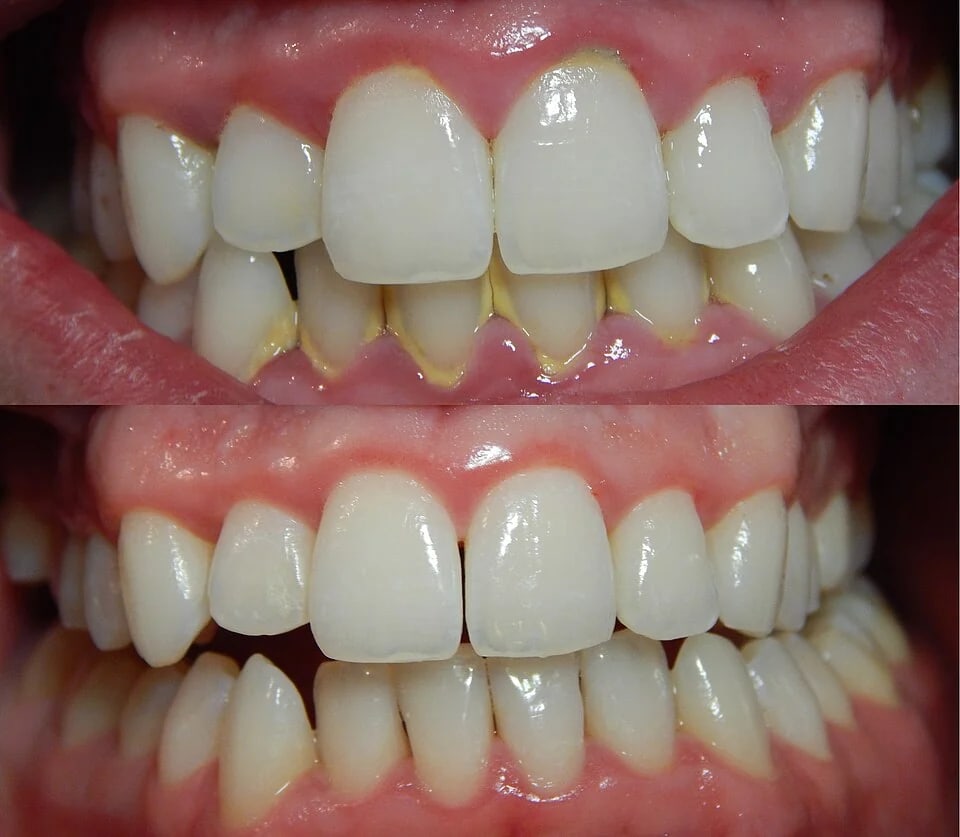
Ordinary gingivitis usually looks like this: the gums turn red and swell, and the gum edge next to the teeth and between them becomes puffy. They bleed during brushing or when chewing hard food.
Pain is usually mild or absent, and sometimes bad breath appears. In teenagers, the gum tissue between the teeth often visibly overgrows. We covered bleeding gums in general in the article “Bleeding Gums”.
When to See a Dentist About a Child’s Gingivitis
If you notice signs of gum inflammation in your child, book a dentist appointment. The dentist will determine the cause and choose the treatment. How soon an examination is needed depends on any accompanying symptoms.
Book an examination
Book a dentist appointment if the gums are red, swollen or bleed during brushing, and the pain is mild or absent. This is the typical picture of gingivitis, and a routine appointment is enough.
When an urgent examination is needed
Contact the clinic without waiting for a routine appointment if any one of these signs is present: the gums are very sore and swollen; there are ulcers or red patches in the mouth; there is a lump on the gums or lip; a permanent tooth is loose. Call and describe the signs.
A loose baby tooth calls for an urgent examination only when the gums around it are sore and swollen. If it is loose without pain or swelling, it is a normal change of teeth: the first baby teeth start to wobble at about age 6, and the molars are replaced at 10–12.
When to see a doctor without delay
See a doctor without delay if your child has a fever and, at the same time, blisters or ulcers on the gums or in the mouth, especially when eating and drinking hurts. This picture does not look like ordinary gingivitis; it can be a sign of a viral infection of the gums and the lining of the mouth. Your child may drink too little, so do not put it off.
How to care for the gums before the visit
Until the visit, brush your child’s teeth twice a day with fluoride toothpaste and make sure the brush reaches the gum line. Do not stop brushing because of bleeding. Keep checking how well your child brushes until about age 12. Clean between teeth that touch each other with floss or a floss holder, suited to your child’s age. It is best to limit sweets and frequent snacks.
Do not choose mouth rinses for the gums on your own. Antimicrobial rinses are not recommended for children under 6, because they may swallow them. At 6–12 years they are used only under an adult’s supervision and when a dentist has prescribed the rinse.
How Gingivitis in Children Is Treated
Treatment aims to remove plaque and the causes that let it build up. At the appointment we examine the gums, teeth and bite, and show your child and you how to clean the areas where plaque is left behind. A toothbrush cannot remove tartar and other hard deposits, so we take them off during professional cleaning. After that we advise when to come back for a follow-up: we check the gums and adjust the care if needed.
If the inflammation is severe or does not go away, we check whether there are other causes, including general health conditions.
When an Individual Assessment Is Needed
If your child takes medicines regularly (for epilepsy, to suppress the immune system, for high blood pressure), the gums may overgrow because of them. Do not change or stop the medicines on your own: the doctor who prescribed them decides.
A chronic illness such as type 1 diabetes also affects the gums. Care is then agreed with the doctor who looks after your child.
Book an Examination
Book an examination with us: we will examine your child’s teeth and gums, advise on brushing and offer professional cleaning if needed. Our pediatric dentists provide it for children; you can read about it on the “Professional Teeth Cleaning” page. General information about children’s treatment is on the Pediatric Dentistry page, and about the examination on the Dental Consultation page.
Sources
- Chapple I., Gizani S., Sanz M. та ін. Gingival and periodontal diseases and conditions in children and adolescents: consensus report (спільний семінар Європейської федерації пародонтології та Європейської академії дитячої стоматології). Eur Arch Paediatr Dent. 2026;27(3):637–670. https://doi.org/10.1007/s40368-025-01154-y
- NHS. Gum disease: symptoms, treatment and prevention. Page last reviewed 20 April 2026. https://www.nhs.uk/conditions/gum-disease/
- American Academy of Pediatrics. When Do Children Start Losing Their Baby Teeth? HealthyChildren.org. Updated 16 October 2026. https://www.healthychildren.org/English/healthy-living/oral-health/Pages/When-Children-Begin-to-Lose-their-Baby-Teeth.aspx
Photos in the article
- Gums before and after plaque removal (illustrative photo; the patient’s age is not stated in the source). Author: Onetimeuseaccount (own work). Original: Wikimedia Commons. License: CC0 1.0. Changes: reduced in size and saved as WebP.
- A dental mirror in a dental office. Author: Katarzyna Zygnerska. Original: Unsplash. License: Unsplash License. Changes: cropped to 4:3 and saved as WebP.
- Cover (illustrative photo): a smiling child. Author: Amanda Sofia Pellenz. Original: Unsplash. License: Unsplash License. Changes: cropped to 4:3 and 16:10 and saved as WebP.

FAQ
What is gingivitis in children?
Why do my child’s gums bleed?
Should we stop brushing if the gums bleed?
Can I rinse my child’s gums with an antiseptic?
Can a child’s gingivitis turn into periodontitis?
Does my child need professional teeth cleaning?
This article is for information only and does not replace a consultation. See a dentist for diagnosis and treatment.