
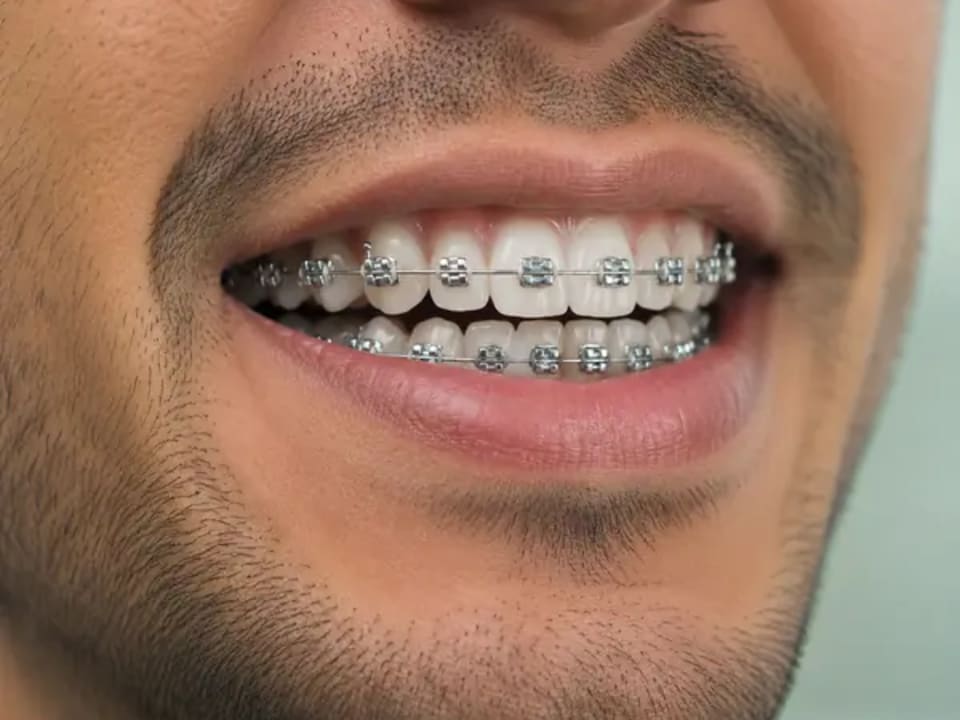
Metal brackets are easy to notice. No point pretending otherwise. For many adults, that is an acceptable trade: the appliance is tough, gives the orthodontist plenty of control and can handle cases that need more than a slight cosmetic correction. We do not begin by picking brackets from a catalogue. First come the bite, gums, roots, fillings and crowns. The choice of appliance follows.
What Makes the System Work?
A row of brackets is only the visible part. Traditional metal braces also include an archwire and tiny ties that secure it. Each bracket is bonded to a particular spot on the tooth; through the slot in its centre runs the wire. Small rubber rings - or, in some cases, fine wire ligatures - stop the archwire from slipping out. In self-ligating braces the wire is held by a built-in clip, so ligatures are not needed.
The wire does the active work. It keeps returning towards its planned shape and, in doing so, applies pressure to selected teeth. Slowly. The bone around the roots responds to that pressure, allowing a tooth to change position without being forced abruptly.
Adjustments are therefore made in stages. The first wire can be surprisingly thin. Another may be fitted later, once the crowded teeth have gained room and the orthodontist needs a different type of control. Tightening everything as much as possible would not make treatment better or safer.
And those little rubber bands? Two things are often confused here. The coloured or transparent rings around a bracket hold the wire in its slot. Elastics worn between the upper and lower jaws serve another purpose: they pull in a prescribed direction and help change the way the teeth meet.
Can Adults Wear Metal Braces?
Yes. The date on a passport tells the orthodontist less than the condition of the gums and supporting bone. Metal braces for adults can be used for crowded teeth, rotations, gaps and various bite problems.
Old fillings and crowns do not automatically rule treatment out. They do, however, need to be recorded. Bonding a bracket to a crown may call for different surface preparation. An implant creates a firmer restriction: it stays where it is, while natural teeth around it may be moved. One fixed point like that can change which teeth move first and how the spaces are managed.
Bleeding gums cannot simply be hidden beneath a new appliance. Neither can active decay. If brushing is already difficult or inflammation is present, those issues are dealt with before the brackets go on. Otherwise, access becomes tighter and a manageable problem quickly becomes inconvenient.
How Are Metal Braces Fitted?
The records appointment involves more than opening wide for a quick look. The orthodontist watches how the jaws meet, photographs the teeth and face, then records the dental arches with a scan or impressions. X-rays answer the questions left over: which way the roots point, whether the supporting bone looks adequate and if any unerupted teeth are sitting out of view.
Next comes preparation. Cavities are treated, the gums are brought under control and professional cleaning may be recommended. Only then is the fitting appointment arranged.
On fitting day, the teeth need to remain clean and dry. Their surfaces are prepared for adhesive, and the doctor positions the brackets one by one. This is rather exacting work. A bracket sitting slightly too high, low or off-centre may guide its tooth along a different path. Once everything is in place, the archwire is threaded through and secured with ligatures. No space is drilled into a healthy tooth for the bracket.
People often worry most about the fitting. In practice, sitting still is usually the tiresome part; the dull pressure tends to arrive later. Teeth may complain when a person bites into something firm, while a cheek can keep finding the same unfamiliar bracket edge. Soup is not mandatory, but softer food and orthodontic wax are welcome for the first few days.
If a bracket comes away or a wire repeatedly scratches the lip, contact us. Pushing, trimming or gluing parts at home tends to create a second problem without solving the first.
Cleaning Around the Brackets
With metal braces on teeth, brushing acquires several new angles. The easy-to-miss strip is often the one between a bracket and the gum. Food also catches beneath the wire and beside the bracket wings - exactly where a quick sweep with a regular toothbrush does very little.
An orthodontic brush handles the larger surfaces. A small single-tuft brush is useful along the gumline, while an interdental brush slips beneath the wire. A water flosser can wash away crumbs, though the soft bacterial film still has to be disturbed with bristles.
Meals need adjusting, not mourning. Slice an apple instead of biting into it whole. Do the same with a firm carrot. Ice, hard nuts, sticky sweets and the end of a pen are less forgiving: one careless bite can detach a bracket and leave that tooth out of the planned movement until the repair.
The Practical Strengths and Drawbacks
Metal systems tolerate everyday orthodontic forces well. The brackets are compact, the doctor can see their position clearly, and the appliance can be used for both modest alignment and more involved bite correction. It is also usually the more economical fixed option.
Visibility is the obvious drawback. Cleaning takes longer, lips and cheeks need time to adapt, and adjustment visits cannot be treated as optional. For some people, those compromises are perfectly acceptable. Others place appearance higher on the list. That discussion belongs in the consultation, once the orthodontist knows which systems are clinically suitable.
