
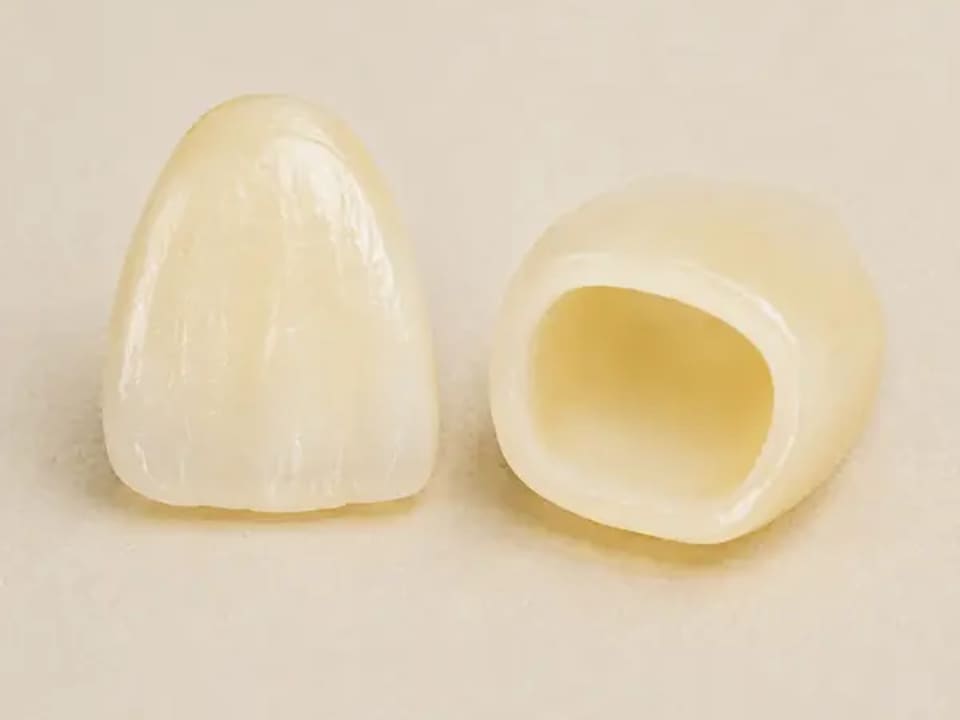
There is a familiar situation: the filling has already been replaced twice, one wall of the tooth is missing, and biting on that side no longer feels reassuring. Another filling may simply be too small a solution. This is where a crown enters the conversation.
More Than a White Cover
Part of the tooth has gone; the crown gives that missing height and contour back. It is made for one patient and one tooth, then fitted over the remaining structure. Unlike a veneer, which is bonded mainly to the front surface, a crown covers the prepared tooth on all sides.
Cut a metal-ceramic crown in half and you will find a grey coping beneath the porcelain. All-ceramic crowns are built differently: ceramic forms the restoration without that metal core. This is especially useful near the front of the mouth, where light, shadow and translucency influence how believable the result looks.
“Ceramic” is still a broad label. A slim incisor and a molar that takes the force of chewing do not need identical constructions. The dentist decides on the material after seeing the tooth and the bite.
When a Crown Becomes the Sensible Option
Picture a molar with a broad filling and only two thin walls left. Technically, another filling might fit into the space. The real question is whether those walls will cope with chewing afterwards.
Ceramic crowns for teeth are considered when decay, a fracture or repeated treatment has removed a substantial amount of tissue. They may also be used for a tooth that is badly worn, unusually shaped or too deeply discoloured for a predictable cosmetic correction with bonding.
Not every damaged tooth qualifies. If a crack reaches far below the gum, the prognosis can change. The same applies when there is too little stable tissue left to hold the restoration. An X-ray, bite check and direct examination settle these questions before any preparation begins.
And the nerve? It is not removed “for the crown”. A tooth with a healthy pulp can stay vital. Root canal treatment is added only when the tooth has another problem inside it.
Ceramic Crowns for Front Teeth
This is the fussy part. In a good way.
Natural enamel is not flat white. Near the gum it tends to look denser; closer to the cutting edge, light behaves differently. There may be tiny ridges, a faint warm zone or a slightly transparent edge. Copy none of that and the new tooth can appear strangely smooth, even when its basic shade is correct.
The base colour can complicate the work. Darkened dentine, a large core or an old post may shine through ceramic with high translucency. The technician has to cover that colour without turning the crown into an opaque white tile.
Shade is normally recorded before the teeth have dried during the appointment. Dry enamel looks lighter for a while. Photographs can also be sent to the laboratory—they show the lip line, nearby teeth and surface texture, details that a shade code cannot describe.
Preparing the Tooth
First, the dentist removes old material that no longer seals properly and checks what is hiding beneath it. Occasionally the tooth is stronger than expected. Occasionally there is barely enough left and a supporting core has to be rebuilt before anything else.
The working area is numbed. A fine outer layer is then shaped away to make room for the ceramic. It is precise, not generous: the crown needs sufficient thickness, but sound tooth is not something to waste.
After preparation, the dentist takes a digital scan or conventional impression. The record includes neighbouring contacts and the opposing teeth—otherwise the laboratory would know the shape but not how the new crown should meet the bite.
A temporary crown covers the tooth during this interval. Be gentle with it. Toffee can wait. When flossing, pull the thread out sideways rather than lifting it hard through the contact. If the temporary comes loose or suddenly feels too high, contact us.
Trying In the Permanent Crown
The finished crown is not cemented immediately. It is seated first, then examined from several angles.
Can floss pass through the contact without shredding? Does the edge sit neatly beside the gum? Which tooth touches first when the patient closes, and what happens during a sideways jaw movement? Thin marking paper helps answer the last two questions.
With a front crown, it is also worth stepping back from the mirror. Close-up detail matters, but so does the way the tooth looks during a normal smile and conversation.
Once the fit, bite and appearance are accepted, the crown is fixed. If it later feels taller than the neighbouring teeth, mention it. Living on the other side of the mouth is not a sensible form of adjustment.
What Happens to the Colour Over Time?
Coffee does not soak deeply into glazed ceramic, yet the area can still look darker when plaque or pigment settles near the gum. This is usually more noticeable where the toothbrush misses the edge.
A hygiene appointment may remove those deposits. Whitening gel will not alter the crown shade, though—it works on natural dental tissue. Anyone considering whitening should discuss the sequence before the laboratory chooses the final colour.
Sometimes the “dark crown” is actually an exposed border. The gum has moved slightly, revealing part of the tooth below. The ceramic may be exactly the same; its surroundings are not.
Care Without Special Rituals
Brush the gumline and clean between the teeth. That is the less glamorous part of keeping a crown, but it counts. Ceramic will not form a cavity; the supporting tooth can develop one at the margin.
There is no fixed retirement date for a crown. Some remain quiet for many years. Others meet a hard nut, persistent grinding or decay at the edge and fail earlier. When clenching leaves visible wear marks, the dentist may suggest a night guard.
Do not skip check-ups merely because the crowned tooth feels fine. Early changes at the margin are usually small and boring—which is exactly how you want to find them.