
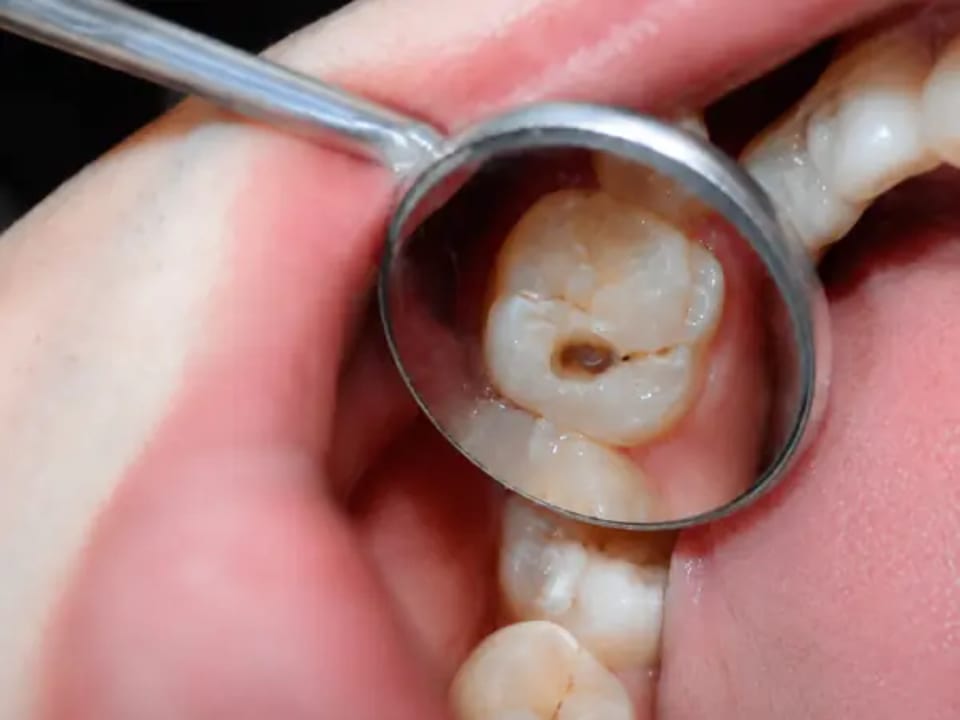
A tooth can look perfectly ordinary from the front while decay grows between it and its neighbour. The opposite happens too: a dark groove may be stained rather than cavitated. With us, the decision to treat is based on a clean, dry examination and, where needed, an X-ray - not colour alone.
Before There Is Anything to Fill
A cavity has a quieter beginning. Acid pulls minerals from the enamel, and under good light the area may look whiter and flatter than the surface around it. Run a tongue across the tooth, though, and there may be no hole to feel. At this point, incipient caries treatment does not automatically involve a drill.
Cleaning, fluoride products and changes to daily plaque control may be enough for a suitable lesion. Resin infiltration can be considered in selected areas. Whatever the method, monitoring matters. A white mark that remains stable and one that continues losing mineral are not the same clinical situation.
The phrase white spot lesion treatment also covers marks with different causes. Some are active decay; others may be developmental enamel changes. Drying the tooth, checking the surface and reviewing its history help the dentist tell them apart.
The stages in short. The final decision is made by the dentist after the examination and, where needed, an X-ray.
| Stage | What happens and what the dentist may consider |
|---|---|
| Early no cavity | What happens: enamel loses minerals, a whiter, flatter area appears. The dentist may consider: cleaning, fluoride products, plaque control at home, resin infiltration in selected areas, monitoring. |
| Cavity in dentine | What happens: decay has reached the dentine. The dentist may consider: removing softened tissue and restoring with a filling. |
| Deep | What happens: the pulp may be close to the cavity. The dentist may consider: judging the risk of exposing the pulp; if symptoms suggest it is involved, a separate pulp assessment and, if needed, endodontic treatment. |
Once the Surface Has Broken
A cavitated tooth cannot rebuild its missing wall. The softened, infected tissue has to be removed and the shape restored with a filling.
After the anaesthetic has taken effect, attention shifts to keeping the tooth dry. The dentist gains access to the damaged area and works through the softened tissue, stopping where sound or preservable dentine begins. Where the decay sits between two teeth, a thin matrix and wedge are used to rebuild the side wall. Without a proper contact, food will pack into the gap every time the patient eats.
The composite is placed in controlled portions, hardened with a curing light and shaped. Last comes the bite check. A strip of coloured articulating paper reveals whether the new filling meets its opposite tooth too early. That tiny high point can make an otherwise good filling uncomfortable.
Deep Decay Needs a Different Pace
During deep caries treatment, the pulp may be separated from the cavity by only a thin layer of dentine. Removing every dark trace is not always the safest target. The dentist judges texture, location and the risk of exposing the pulp, while making sure the outer margins can be sealed properly.
Symptoms change the plan. A brief response to cold is one thing. Pain that starts on its own, wakes the patient or lingers after heat may mean the pulp is already involved. In that case, a routine filling may no longer be enough. A separate pulp assessment comes first and, if needed, endodontic treatment.
Decay near an exposed root or gumline creates another challenge. For dental root caries treatment, moisture control is awkward and the affected surface is softer than enamel. Gum recession, dry mouth and plaque sitting close to the neck of the tooth often need attention alongside the filling.
Several Cavities at Once
Multiple cavities are rarely tackled at random. The painful or deepest teeth usually come first; smaller lesions can follow in a planned sequence. The dentist also looks for whatever keeps feeding the problem - frequent sweet drinks, grazing between meals, dry mouth or plaque left between the teeth.
A row of new fillings treats the damage already present. It does not remove the conditions that produced it. That part happens at home, with realistic changes rather than a perfect routine kept for three days.
Painless Cavity Treatment
Local anaesthetic is used before sensitive tissue is prepared. A patient may still notice vibration, movement or pressure. Sharp pain is different and should be mentioned immediately; there is no prize for staying silent until the appointment ends.
At some appointments, the next thing the patient sees is a blue or green sheet around the tooth. That is the rubber dam. It separates the working area from saliva and keeps the tongue and cheek away from small instruments. For adhesive work, the dry field is the useful part - moisture can interfere with the bond long before it is visible.
